Safrimba: Reinventing the Savings Circle with Fully On-Chain, Permissionless Smart Contracts
The Oldest Financial Product in the World, Rewritten in Code
Rotating savings and credit associations are one of the oldest forms of collective finance on earth. Across Africa they are known as tontines, likelemba, esusu, stokvels, susu, ajo, chilimba. The mechanics are simple and universal. A group of people agree to contribute a fixed amount on a fixed schedule, and on each cycle one member receives the pooled sum. Over the full round, every member contributes the same, receives the same, and gains access to a lump sum they could not easily reach alone.
These circles have quietly moved trillions of dollars outside the formal banking system for centuries. They finance school fees, weddings, funerals, shop inventory, motorbikes, market stalls, and countless other real economic needs. They work because the group enforces the rules socially.
But they have always shared the same weaknesses. The organizer holds the money. If the organizer disappears, the money disappears with them. Membership depends on who you know. Rules are verbal. Accounting is opaque. And a single dispute can break the entire round.
Safrimba takes this deeply human financial primitive and makes it cryptographically enforceable. It is a fully on-chain, permissionless protocol for savings circles on Safrochain. The rules are a smart contract. The funds are held by the contract. The payouts are automatic. There is no organizer with custody, no admin with override, and no approval list for membership.
This post explains how Safrimba works, why every part of it lives on-chain, and what “permissionless” really means when the code is the only thing in charge.
How a Safrimba Circle Works
A Safrimba circle is defined by four parameters, chosen when the circle is created:
-
The contribution amount each member commits to pay every cycle.
-
The number of members the circle expects (for example, 12).
-
The cycle duration (for example, 30 days).
-
The payout order, which can be fixed at creation, randomized on-chain, or auctioned each cycle depending on the circle type.
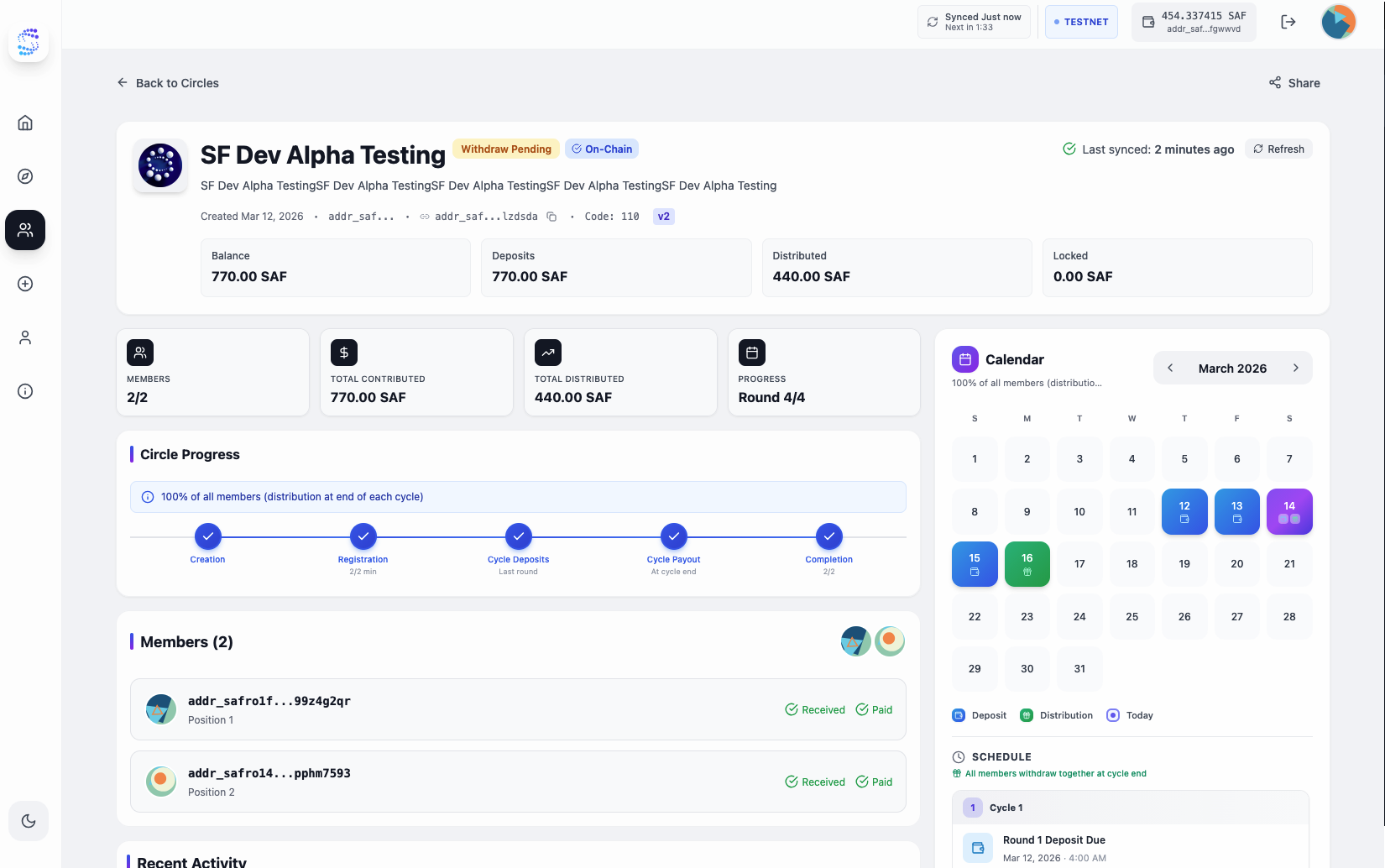
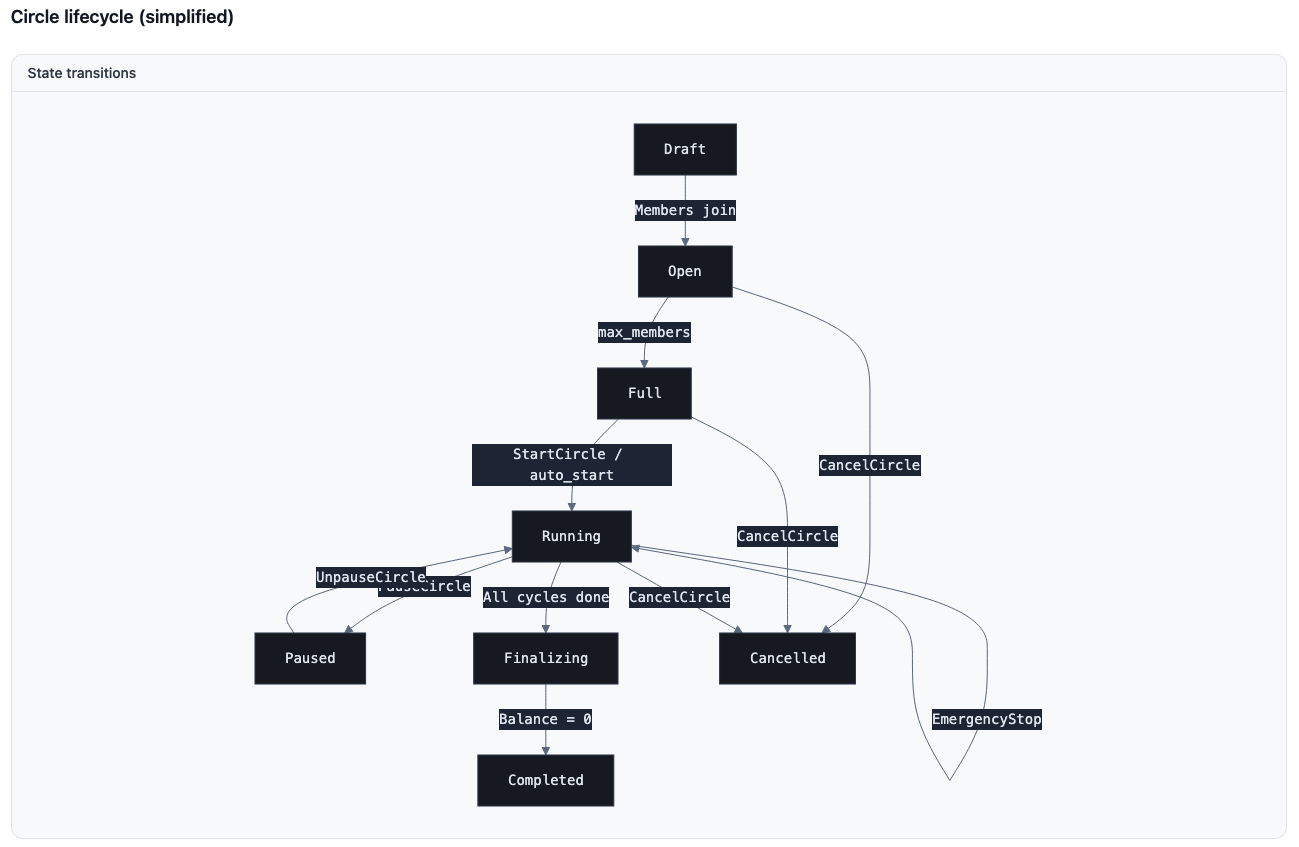
Once deployed, the contract opens for members to join. When the required number of members is reached, the circle activates and the first cycle begins.
At every cycle:
-
Each member transfers the contribution amount to the contract’s escrow.
-
The contract verifies that every member has paid.
-
The full pooled amount is released to the member whose turn it is, automatically.
-
The next cycle begins.
The round completes when every member has received one payout. At that point the contract has fulfilled its purpose, its escrow is empty, and it remains permanently on-chain as a verifiable record of what happened.
The entire flow is deterministic. Given the same inputs, the contract produces the same outputs, every time, for every participant, with no human in the loop.
Fully On-Chain by Design
“On-chain” is a word that gets stretched until it means very little. A project can call itself on-chain while the frontend calls a centralized API that calls a centralized database that eventually writes a hash somewhere. Safrimba is on-chain in the strict sense. Every piece of state that matters lives inside Safrochain smart contracts.
-
Circle definitions (amount, members, duration, payout order) are stored on-chain.
-
Member list is an on-chain registry, readable by anyone.
-
Contributions are token transfers to a contract address. There is no off-chain ledger recording who paid; the ledger is the blockchain itself.
-
Escrow balances are the contract’s token balances, visible on any block explorer.
-
Payouts are token transfers from the contract, triggered by the contract’s own logic.
-
Payout order, cycle counter, and round history are all contract state.
There is no backend server that could go down. There is no database that could be edited. There is no API key that could be revoked. There is no operator who could be pressured, compromised, or simply disappear with the funds.
If the Safrimba website went offline tomorrow, every existing circle would continue to run to completion, and any member could interact with their circle directly through the contract using any Safrochain-compatible wallet or block explorer. The website is a convenience. The protocol is the product.
Permissionless, Not “Permissionless-But”
Permissionless is another word that often arrives with footnotes. Many “permissionless” protocols quietly require a whitelist, a KYC check, a fee-payer, a governance vote, or an allowlist of approved integrators. Safrimba has none of these.
Anyone can create a circle. A single wallet transaction deploys a new circle with the parameters the creator chose. There is no application. No review. No approval queue. No listing fee to an admin.
Anyone can join a circle that is still open. If the circle has room, a wallet can join by calling the join function and locking in the first contribution. There is no identity check, no regional restriction, no invitation. Whether you are a farmer in Mbanza-Ngungu, a developer in Lagos, a nurse in Nairobi, or a merchant in Abidjan, the contract sees a wallet address and a valid contribution, and that is enough.
No one can remove a member. Once a member has joined and paid, their seat is theirs. The creator of the circle cannot kick them out. No admin multisig can override their turn. The only way a member leaves the circle is by completing their cycles.
The absence of these escape hatches is not a missing feature. It is the feature. It is what makes the protocol trustable to people who have been failed, historically, by the trust-based version.
What the Smart Contract Actually Enforces
A Safrimba contract is a set of rules that execute when invoked. The rules do not ask for permission; they simply check their conditions and either succeed or revert. The guarantees it provides to every member are:
Custody guarantee. Contributions are held by the contract, not by the organizer. No private key controlled by a human can move those funds outside the rules of the contract.
Integrity guarantee. The payout amount for the current cycle is always equal to the sum of contributions received for that cycle. The contract computes it on the fly from its own balance. There is no stored “payout amount” that could be tampered with.
Order guarantee. The payout recipient for each cycle is determined at circle creation (by fixed order, by on-chain randomness, or by auction) and cannot be changed mid-round. When the cycle ends, the payout transfer is executed to that predetermined address, and nothing else.
Liveness guarantee. As long as members contribute, cycles progress. The contract does not depend on any off-chain cron job or server to “tick” it forward. The next cycle advances when the conditions of the current cycle are met.
Exit guarantee. Once a member has received their payout and the round completes, the contract releases them. There is no perpetual lock, no renewal clause, no opt-out fee.
Transparency guarantee. Every parameter, every contribution, every payout, and every state transition is a public on-chain event. Any member, and any non-member, can independently audit the full history using a block explorer.
The contract does not need to be trusted. It can be read.
Handling Defaults the On-Chain Way
Real circles have to handle the hard case: a member who stops paying. Safrimba handles default through mechanics that are encoded in the contract at creation time, rather than by inviting a human arbiter to decide case by case.
Depending on the circle type chosen at deployment, defaults are handled through mechanisms such as:
-
Collateral bonds. Members can be required to lock an on-chain bond at join time. If they miss a contribution, the bond is used to cover the missing amount, keeping the round whole for the other members.
-
Late-payment windows. A grace period after the cycle deadline, during which a member can still pay (with or without a penalty) before the default is realized.
-
Proportional redistribution. If a member defaults irreversibly and no bond covers the gap, the remaining payouts are recalculated proportionally so the round continues fairly for everyone else.
-
Slot auctions. For auction-type circles, each cycle’s payout is auctioned among members who want it first, with the discount redistributed to the rest, aligning incentives and pricing impatience transparently.
All of these rules are visible before you join. The protocol does not hide them in a settings page that an admin might change later. Every rule that can affect your money is written into the contract address you choose to interact with.
Composability: A Savings Circle That Plugs Into DeFi
Because Safrimba circles are smart contracts on Safrochain, they compose with the rest of the ecosystem. A few directions this opens up:
-
Yield-bearing circles. While contributions wait in escrow between cycles, they can be routed through audited vaults that earn yield, with the yield returned to members according to contract rules.
-
Stablecoin circles. Denominating a circle in a Safrochain-compatible stablecoin removes the volatility that has historically made on-chain savings uncomfortable for everyday use.
-
On-chain credit history. Completing circles generates a verifiable, portable record of contribution reliability that other Safrochain protocols can use to offer credit, without exposing a user’s personal identity.
-
Cross-chain circles. Thanks to Safrochain’s cross-chain interoperability, a circle can in principle accept members holding assets on other chains, with bridged deposits settled into a single on-chain escrow.
None of this requires Safrimba to be upgraded. New behavior is new contracts that interact with existing ones. Old circles keep running by their original rules, forever.
What Security Looks Like Here
When custody is removed from a human, the attack surface moves to the code. That is a trade-off worth naming openly. Safrimba’s security posture rests on four things:
-
Minimal, auditable contracts. The core circle contract is intentionally small. Fewer lines of code means fewer places for bugs to hide.
-
Open source. Every contract is public, on-chain and in the Safrimba repository. Anyone can read it, fork it, simulate it, and reproduce its behavior.
-
Immutability. There is no proxy, no admin key, no upgrade path that could be hijacked. The contract you join is the contract that runs.
-
Progressive rollout. Safrimba ships on testnet first, with a capped mainnet launch that grows as audits, bug bounties, and real-world usage mature.
A circle on Safrimba is exactly as trustworthy as the contract code it runs on. That code is public. Trust moves from a person in a room to a function you can read.
Why This Matters
Financial inclusion is not a slogan. For hundreds of millions of people, the formal banking system is expensive, distant, or simply uninterested. Traditional savings circles already serve those people, because they work with what the community actually has: relationships, weekly cash flow, and collective discipline.
Safrimba keeps what works about that model and fixes what breaks it. It keeps the discipline of fixed contributions, the solidarity of shared commitment, the lump-sum access that makes real purchases possible. It removes the organizer risk, the geographic limit, the opacity, and the dependence on a single trusted human.
The result is a savings primitive that is available to anyone with a wallet, runs without permission, settles without intermediaries, and cannot be shut down by anyone, including us. Exactly the way financial tools should work on a public blockchain.
Getting Started
Safrimba is live on the Safrochain testnet today.
-
Get a Safrochain-compatible wallet.
-
Fund it with testnet tokens from the Safrochain faucet.
-
Visit safrimba.safrochain.com.
-
Browse existing circles, or create your own by choosing a contribution amount, a member count, a cycle duration, and a payout order.
-
Connect, join or create, and the contract takes it from there.
-
Visit docs Safrimba - Decentralized Savings Circles | Blockchain-Powered Likelemba
-
Smartcontract github repo GitHub - Safrochain-Org/safrimba-smartcontract-v0: A CosmWasm smart contract implementing a digital tontine system on Safrochain. The contract manages all deposits, rules, and payouts in SAF tokens automatically. · GitHub
No email. No signup. No admin approval. Just a wallet and a decision.
Welcome to Safrimba.